Product Overview
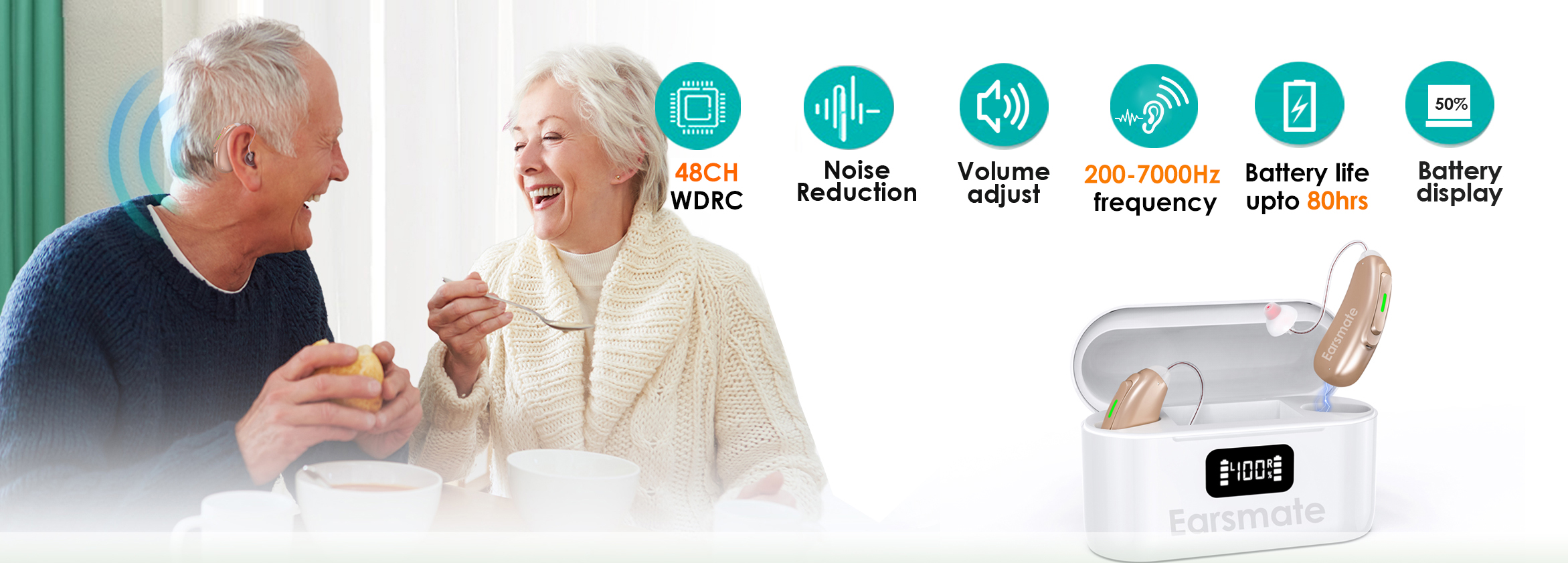
Inside this 48 channel WDRC digital hearing aid, incoming sound is split into 48 frequency bands and each band is compressed on its own, so a voice across the table and a clattering plate beside it are handled separately instead of being pushed through one volume setting. What you see is simple: a beige housing behind the ear, a clear thin tube, a soft silicone dome resting in the canal, and speech that keeps its shape at a comfortable level.
It arrives ready to wear: a noise reduction 48 channel OTC hearing aid for noisy environment use, with no software to program, no app to install and no pairing step — the rocker button on the housing changes listening mode, volume and tone by touch. A left and a right unit come in the box, so the pair is matched from the start rather than bought one side at a time. Bluetooth streaming is deliberately left out: this is a hearing aid first, and it will not interrupt a conversation with notifications.
Earsmate has been building hearing aids since 2016, and the habits of a high quality digital hearing aid brand show in the details that are easy to overlook — a dome that seats without pressure, a case that closes firmly, a tube that does not kink.
48-Channel WDRC Processing
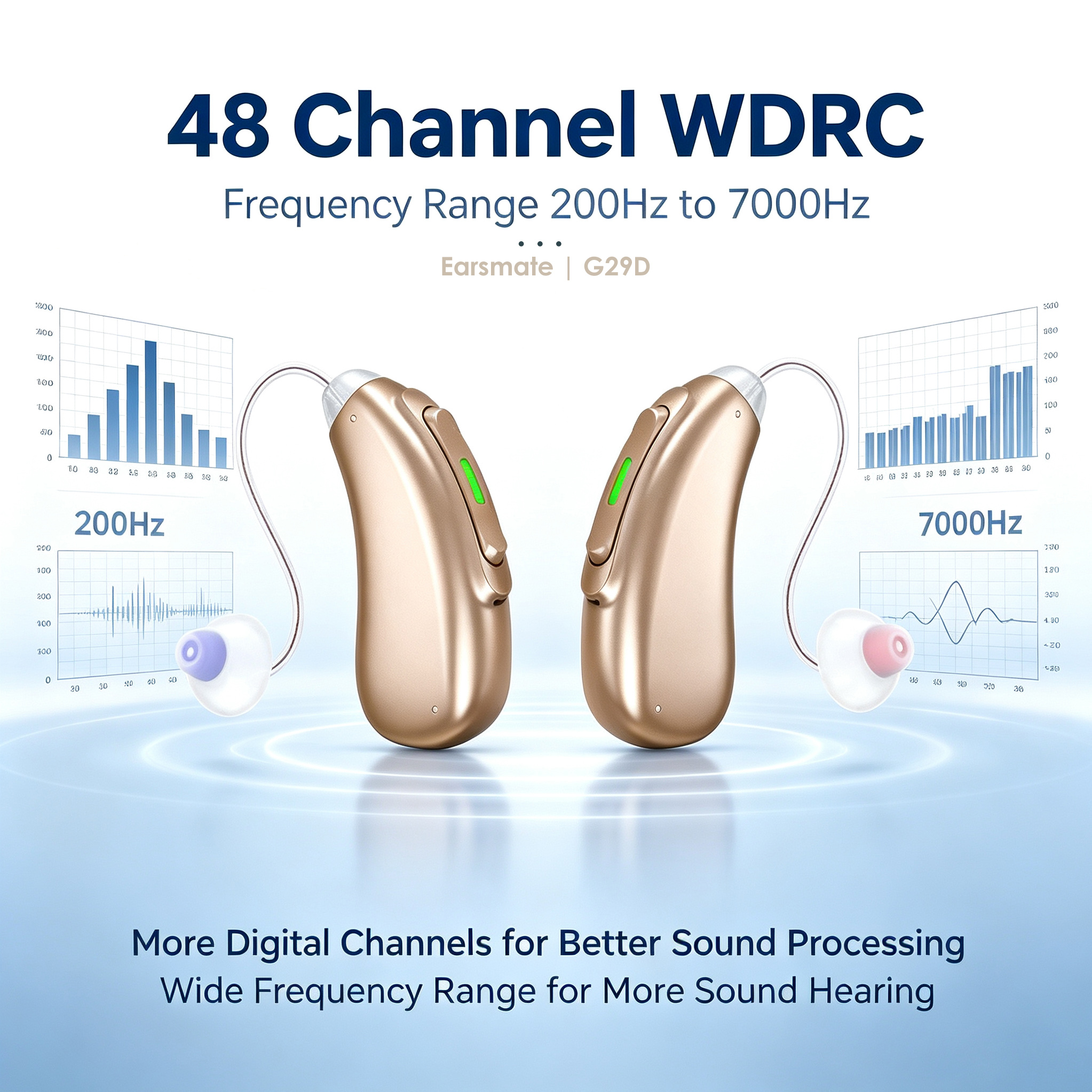
- 48 bands instead of one — inside this noise reduction 48 channel OTC hearing aid for noisy environment listening, the processor divides incoming sound into 48 channels, so a soft consonant and a loud vowel are amplified by different amounts rather than together.
- What compression does for speech — wide dynamic range compression narrows the distance between quiet and loud sound, which is how a voice at the far end of a room stays audible without the nearest voice turning harsh.
- Reach into the high frequencies — the working range climbs to the region where the consonants that carry meaning in speech sit, so words ending in s, f, t and sh keep their edges instead of blurring into a mush.
- Set for everyday listening — the output is balanced for conversation, television and group talk in mild to moderate hearing loss, not for profound loss or clinical fitting.
- Low distortion — amplified speech keeps its natural shape instead of turning metallic when the volume climbs.
- A quiet electronic floor — the circuitry adds very little hiss of its own, so a silent room stays silent rather than humming.
- One job, done properly — this is a 48 channel WDRC digital hearing aid for listening, not a headset, so nothing competes with speech processing.
Intelligent Noise Reduction
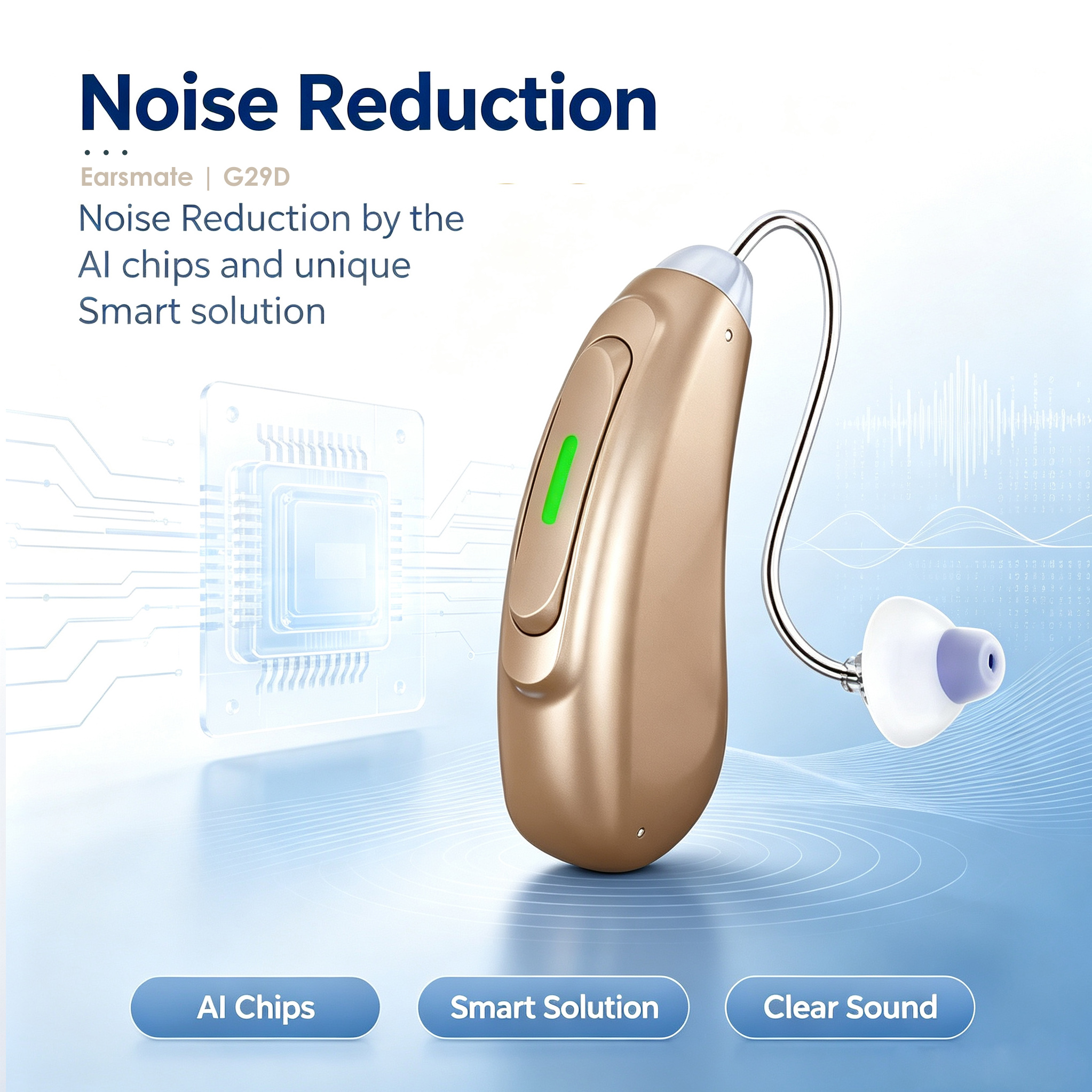
Background noise is where a hearing aid is judged. The noise reduction here runs on AI chips that separate the shape of speech from the steadier sound around it — fans, traffic, cutlery, the hum of a busy room — and lifts the speech while pushing the rest back. It is not a mute button; the aim is proportion, so the person in front of you comes forward without the world going silent.
In practice, that is what separates a hearing aid from an amplifier. A noise reduction 48 channel OTC hearing aid for noisy environment listening has to decide, band by band and moment by moment, which part of the incoming sound deserves gain, while a plain amplifier simply turns everything up and brings the room with it. That is why settings that work in a quiet kitchen so often fail in a restaurant.
Give it a fair trial. Sit where you can see the speaker's face, choose the restaurant mode before the noise builds rather than after, and allow a few weeks for your ears to settle into amplified sound. Very loud rooms — a packed canteen, a live band — remain hard work for any hearing aid, and this one is honest about that.
Fit & Feedback Control
- Why whistling happens — a little sound escapes the canal, finds the microphone behind the ear and loops; the whistle is that loop, and a dome that is too small or not seated is the usual cause.
- Adaptive suppression on board — the device detects the start of the loop and cancels it, which is why whistling is nearly zero once the dome is matched to your ear.
- Start with the domes — three sizes come in the box; try each in turn, aiming for a seal that is snug but never painful. If it aches after ten minutes, step down a size.
- Check the tube — the thin tube should follow the curve in front of the ear without kinks or twists; a bent tube leaks sound and invites feedback.
- Keep wax out — a dome or tube partly blocked with wax both dulls the sound and raises the chance of whistling, so brush it out at the end of each day.
- When to ask us — if feedback persists after a dome change and a clean, contact us before deciding the unit is faulty; a different dome size usually solves it.
Mini RIC Design
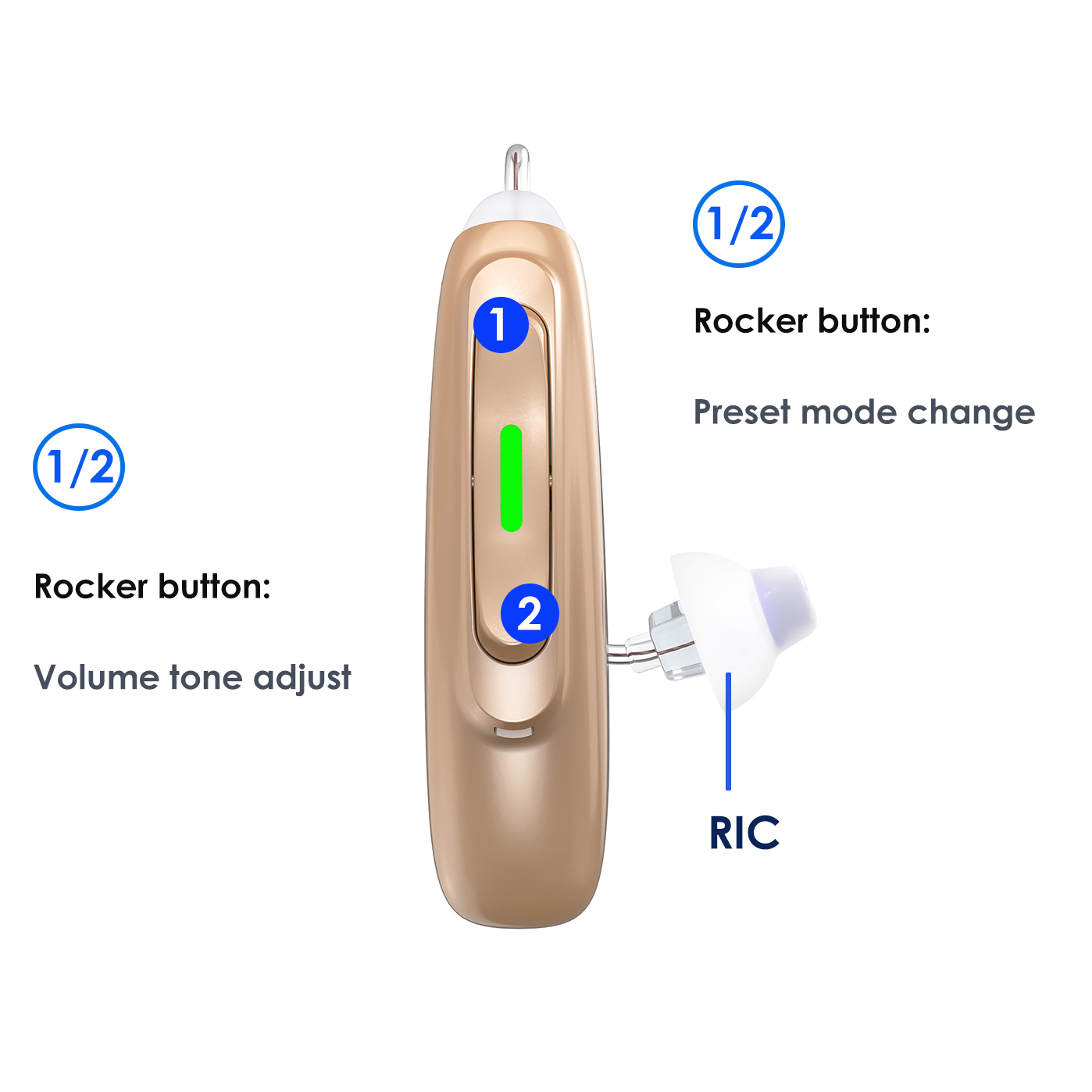
RIC means the receiver sits in the canal rather than in the housing behind the ear. Here that is a slim beige case tucked behind the ear, a clear thin tube, and a soft silicone dome resting at the canal opening. From across a table the tube is the only part most people will notice.
The comfort comes from what is missing. There is no bulky earmould filling the bowl of the ear and nothing pressing on the canal wall the way a custom shell does; the dome sits lightly, the housing stays put, and the assembly is light enough to forget during a long afternoon. Because the rocker control is on the housing itself, a change of mode or volume needs no phone, no remote and no glance in a mirror.
Expect a short settling-in period. A new dome can feel warm or slightly full for the first days, which usually passes as the canal adjusts. If it does not, the dome size is the first thing to change rather than the device. The beige housing sits quietly against skin and hair, and the clear tube catches less light than a tinted lead would.
Battery & Charging
- 70 to 80 hours per charge — a full charge covers a long week of daily wear, with heavy all-day use landing at the lower end and lighter use at the top.
- 1.5 to 2 hours to refill — plug in over breakfast and the units are ready again well before lunch.
- The case works as a power bank — the portable charging case holds enough for 3 to 4 further recharges, so a weekend away needs no wall socket.
- Battery-level display — the case shows remaining charge, so you can see when it is time to plug in instead of discovering it mid-conversation.
- USB-C charging — the socket is the same one your phone uses, so a phone charger, laptop port or power bank you already own will do the job.
- Lithium instead of disposables — there are no zinc-air cells to buy, store or swap, which matters most for users whose hands are not steady.
- A routine that sticks — charge both units overnight in the case and the device is never the reason a conversation is missed.
Listening Modes & Controls
Four presets cover most of a normal day: quiet home, outdoor, restaurant and meeting. Each one shifts how much gain goes to speech and how firmly the background is held back, so you are changing the character of the sound rather than simply its loudness. Choosing the right preset before you walk into a room does more for intelligibility than turning the volume up afterwards.
Volume and tone live on the same rocker button as the preset. A press cycles the mode, and the same control lets you raise or lower the volume and ease the tone brighter or warmer when voices sound sharp or muffled. It is all done by feel on the housing — no screen, no menu, nothing to memorise.
For the first week, start in quiet home mode at a low volume and change one thing at a time. Most users settle on one preset for indoors and one for going out, then leave the volume alone and let the device do the work.
Specifications
| Product | Rechargeable OTC digital hearing aids for sale online |
| Model | Earsmate G29D |
| Peak OSPL 90 (dB SPL) | 110dB ± 5dB |
| HAF OSPL 90 (dB SPL) | 105dB ± 5dB |
| Sound gain / max | 35dB ± 5dB |
| Total harmonic wave distortion | 2% |
| Frequency range (Hz) | 200Hz – 7000Hz |
| Equivalent input noise (dB) | 25dB |
| Bluetooth streaming | No |
| Battery type | Rechargeable lithium battery |
| Battery time for hearing | 70–80 hours |
| Charging time | 1.5–2 hours |
| Charger case | Portable, acts as a power bank for 3–4 recharges |
| Charge power | Type-C DC 5V |
| Certificates | FDA, ISO13485, FCC, ROHS, CE, CFS |
| Warranty | 1 year |
Packing & Box Contents
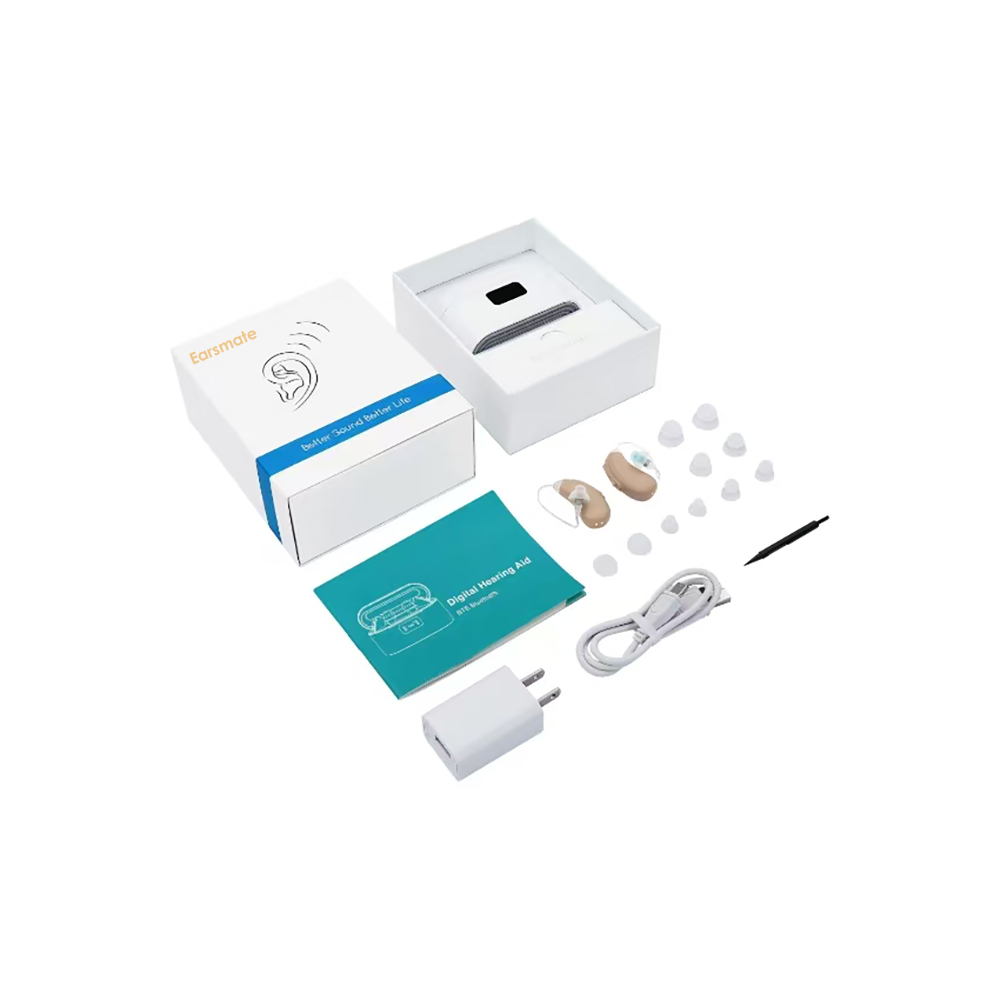
- 1 pair of hearing devices — one unit for the left ear and one for the right, matched as a left-and-right pair.
- 1 power adapter — supplied in EU or US type.
- 1 USB-C charging cable — the same connector used by most current phones.
- 3 ear domes — large, medium and small, so the seal can be adjusted at home.
- 1 cleaning brush — sized for the dome opening and the tube.
- 1 user manual — covering charging, dome fitting and control basics.
- Retail packaging — a printed outer box with a moulded insert that holds the charging case, domes, cable and brush in their own recesses, so nothing shifts in transit.
Reasons to Buy Online
What you are buying with an over-the-counter device is time and control: no clinic appointment, no ear impression and no return visit to have a program adjusted. Earsmate has worked since 2016 as a high quality digital hearing aid brand, and this model is the version of that idea aimed at conversation in company — a RIC housing that stays comfortable through a full day and controls you can work without looking.
The case for going digital rather than amplified is easiest to hear in company. The processing here does the job a single-setting amplifier cannot: it holds speech steady while the room moves around it, so a family gathering or a work lunch stays followable instead of becoming a wall of sound.
Be clear about the limits before ordering. This is a device for mild to moderate hearing loss, not for severe or profound loss, and it does not replace medical advice on a sudden change in hearing, ear pain or a suspected blockage. It is also not a streaming device, so anyone who wants music and hands-free calls should look at the Bluetooth models in the range instead.
Ordering & Delivery
- What you receive — one boxed pair with the domes, brush, cable, adapter and manual described above; nothing else needs buying before first use.
- Warranty — this model carries a 1-year warranty, so keep the order confirmation, since it is what we ask for if a claim is ever needed.
- Lead time and shipping — confirm current lead time and shipping cost with our team before ordering; both depend on destination and stock at the time.
- Payment and import charges — ask us which payment methods are available for your country, and check what your own customs office may charge on arrival.
- Returns — returns and refunds follow the store's published return and refund policy; read it before ordering if you are unsure about fit.
- After delivery — first-time users can write to us for help with dome size, charging or choosing a preset; setup questions are part of normal support.
Other Earsmate Models
Earsmate keeps a small, deliberate range rather than a long catalogue, and four other models sit alongside this one. The Earsmate G29 adds phone-app control and Bluetooth for music and calls; the Earsmate G22 is app-controlled for general hearing-loss assistance; the Neckband Bluetooth earphone hearing aid moves the electronics into a neckband for a looser fit; and the Bluetooth bone conduction headphone hearing aid leaves the ear canal open entirely.
This model is the one to choose when speech clarity in noise, a wide frequency range and a discreet RIC fit matter more than streaming. If calls and music are part of daily life, one of the Bluetooth options will serve you better from the first day.
Warranty & After-Sales
Every Earsmate hearing aid is backed by a 12-month warranty, so you can settle into daily use knowing we stay with you after checkout. If sound feels off or a unit stops working as it should, contact us with your order number and model; we will walk you through checks on charging, cleaning and control settings first, then agree the next step if a repair or replacement is needed. We also help with first-time setup, battery and charging care, and everyday upkeep, and can advise on the right accessories for the model you own.
FAQ
Q1. Who is this OTC hearing aid suitable for?
It is made for adults and seniors with mild to moderate hearing loss — the everyday situation where conversation, television and group talk have become hard work but sound is still audible. It is not intended for severe or profound loss, for children, or for anyone with active ear pain, discharge or a suspected wax blockage; those cases need a clinician first.
Q2. How long does a full charge last?
Expect 70 to 80 hours of hearing from a full charge, refilled in about 1.5 to 2 hours. In real use that usually works out as charging once a week, and the case can top the units up three or four more times before it needs a socket itself.
Q3. Does this OTC hearing aid whistle easily?
Whistling is a fit issue more than a device issue, and this model tackles it from both sides: adaptive feedback suppression cancels the loop electronically, and three dome sizes let you close it off physically. With the right dome seated properly, whistling should be rare. If it starts, check the dome and the tube before anything else.
Q4. Can I adjust the sound settings?
Yes — four presets for quiet home, outdoor, restaurant and meeting, plus volume and tone, all on the rocker button. Most people settle on one preset for indoors and one for going out, then leave the volume alone.
Q5. Does it stream music or phone calls over Bluetooth?
No. This is a 48 channel WDRC digital hearing aid built for listening, and Bluetooth streaming is not part of it — no pairing, no notifications, no app to manage. If streaming matters to you, the Bluetooth models in the Earsmate range cover calls and music.
Q6. Will it help me follow conversation in a busy restaurant?
That is the situation it was designed around. The noise reduction holds speech forward while the room stays behind it, and the restaurant preset does the same job with a firmer hand. Sit away from the kitchen and face the person you are with; even a good hearing aid works better with a clear line of sight.
Q7. How is this different from a personal sound amplifier?
A personal amplifier raises everything at once. This unit processes 48 bands separately, cancels feedback electronically, and is built to medical-device management standards rather than consumer audio ones — the working habits of a high quality digital hearing aid brand rather than a generic amplifier. The practical difference shows up in noise, where speech stays intelligible instead of simply getting louder.