We use cookies to Improve your online experience. By continuing browsing this website, we assume you agree our use of cookies.
Home > Behind-the-Ear Hearing Aid Buying Guide

Behind-the-Ear Hearing Aid Buying Guide

Behind-the-Ear Hearing Aid Buying Guide

Choosing a hearing aid usually comes down to one question: how much power do you actually need? A behind the ear hearing aid keeps the electronics in a compact casing that rests behind the ear, with sound carried into the ear through a tube or mould — and it still offers the most amplification headroom of any style. That headroom is exactly why a high-power bte hearing aid is the usual starting point for severe to profound hearing loss, while lighter BTE fittings suit milder losses and people who simply prefer easy handling. This guide works through severity, the controls you will touch every day, the over-the-counter versus clinical path, and a scenario-based shortlist that includes the Earsmate G26 SP.

  • Severe to profoundHigh-power BTE built for this range
  • Up to 200 hoursPer A675 zinc-air battery
  • CE, FCC, RoHSAlso listed as FDA / ISO13485
Hearing Aid for severe hearing loss

Start With Your Level of Hearing Loss

Two people can buy the same shape of aid and need very different amounts of output. Read the description that sounds most like daily life, then follow that path — power is the decision that everything else hangs on.

Path A

Mild to Moderate Loss

You follow one-to-one conversation in a quiet room, but restaurants, group tables and television volume become a daily negotiation. Speech is audible, just not always clear.

People in this range typically fit an open-fit receiver-in-canal, in-the-ear or completely-in-canal device. A behind-the-ear shell still works well when you want larger buttons, easier handling and a bigger battery.

Buyer decisionBuy comfort and clarity, not maximum headroom you will never use. Correct fit and regular use matter more than the printed output ceiling.

Path B

Severe to Profound Loss

Conversation needs repetition, group talk is mostly lost, and you rely on lip reading. Other people complain about the TV volume, and the telephone is difficult without extra help.

This range needs maximum output from a large receiver and a well-sealed earmould or tube. The Earsmate G26 SP high power BTE is designed for severe to profound hearing loss and gives you digital MPO/NH trimmers to set the maximum power output and frequency response.

Buyer decisionPrioritise output headroom, telecoil access and controls you can adjust by hand — then confirm fit with a hearing professional.

Feature Decoder: What the Labels Really Mean

Specification sheets are written for clinicians, not for the person wearing the aid. Here is each term in plain English, why it changes your day, and how the Earsmate G26 SP handles it.

Severe to profound hearing loss

The G26 SP is built for the higher-gain end of the market: adults and seniors whose hearing loss sits in the severe to profound range. That is why the listing pairs a high-power behind-the-ear receiver with adjustable trimmers instead of a fixed, over-the-counter response.

MPO and NH digital trimmers

MPO sets the maximum power output the aid can deliver; NH shapes the frequency response. Both are set with a small digital trimmer, so the fitter can cap loudness for comfort and lift the frequencies a wearer needs without returning the aid to the factory.

Telecoil

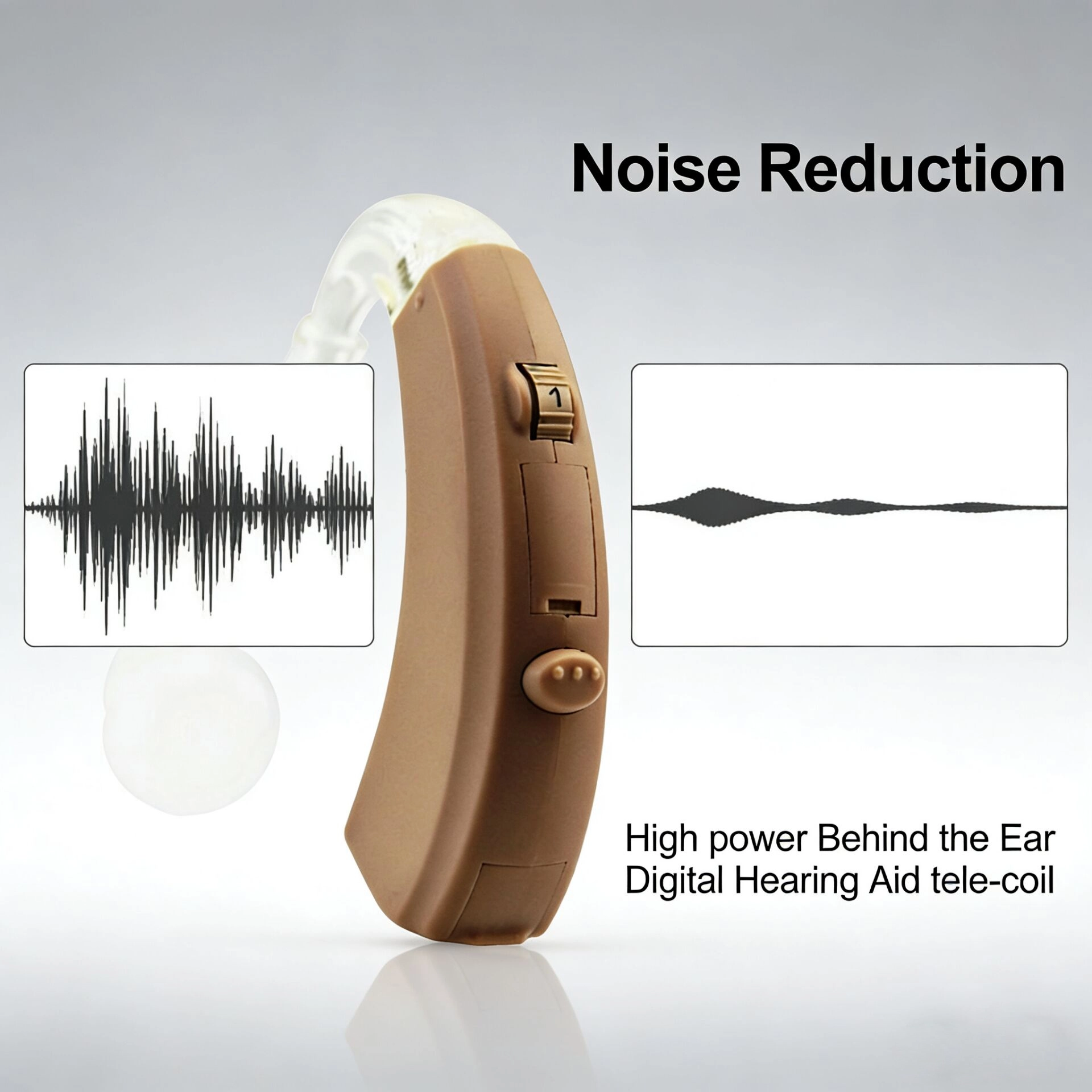
A telecoil picks up the magnetic field from a hearing loop rather than sound through a microphone, so room noise and distance drop out of the signal. The G26 SP includes a phone telecoil, which lets theatres, churches and auditoriums that run loop systems feed audio straight into the aid.

A675 battery and runtime

The aid runs on a Zinc Air A675 cell rated at up to 200 hours of continuous use. Longer runtime means fewer battery changes for a wearer who may not handle small cells easily, and a consumables cost you can estimate per year rather than per week.

Feedback and noise handling

Feedback control and noise-reduction algorithms work on the two problems that make amplification tiring: whistling caused by leakage around the earmould, and background noise competing with speech in busy rooms such as group meetings or public events.

Certifications to plan for

The listing records CE, FCC, RoHS and FDA/ISO13485 compliance. For a distributor or a clinic these are the documents buyers ask for first, so confirm the current certificate set with the supplier before you quote a market.

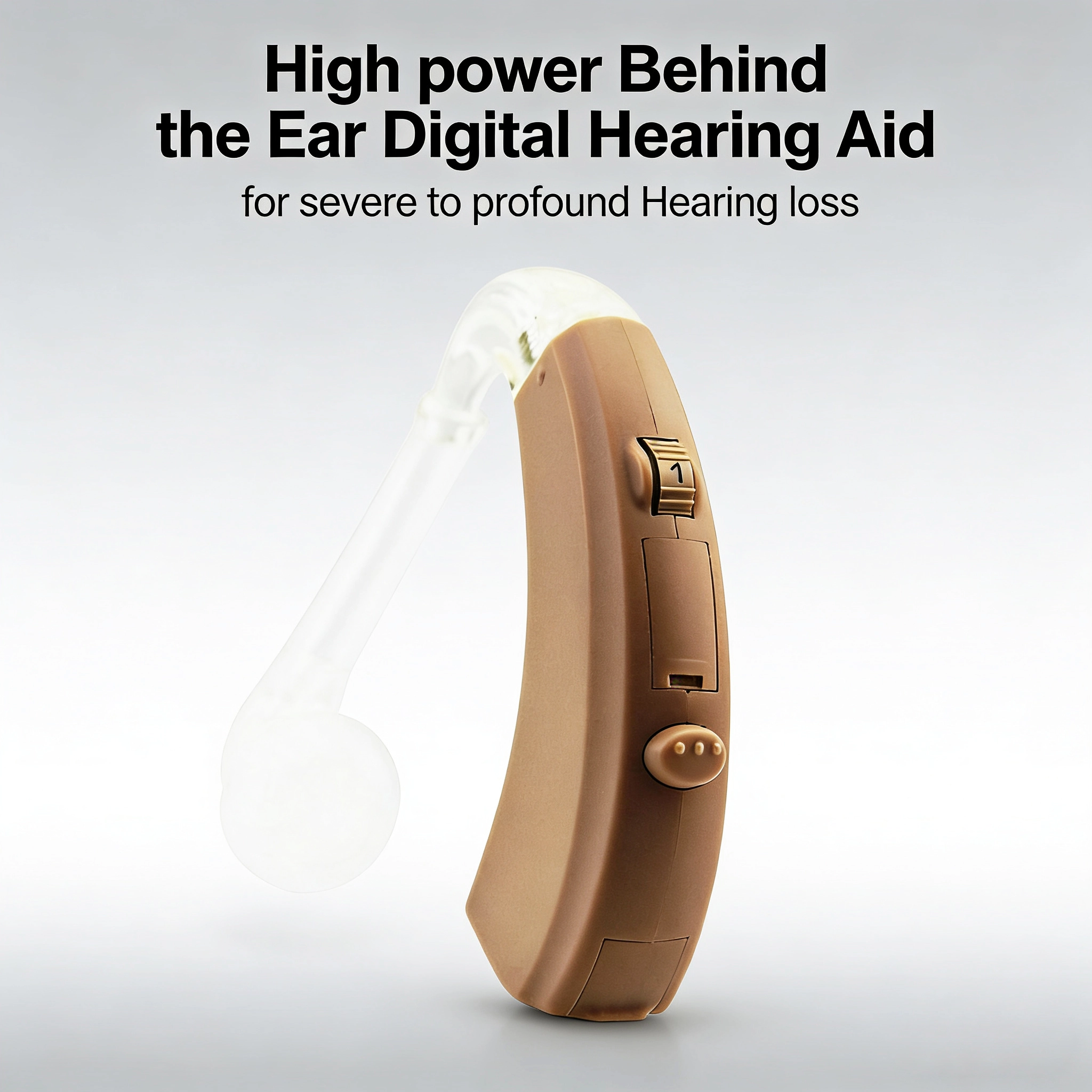
High power BTE hearing aid for profound hearing loss showing the beige behind-ear housing
Behind-ear controls, battery door and housing layout — the parts you touch every day.

BTE vs RIC, ITE, CIC and Bone Conduction

Before you commit to a behind-the-ear fitting, check what you trade away. The table below compares the main hearing aid styles on the factors that decide most purchases.

Style Where it sits Power headroom Visibility Battery Typical candidate
Behind-the-ear (BTE) Electronics behind the ear, sound through a tube or earmould Highest — largest receiver options Moderate, but often hidden by hair Larger zinc-air button cells, selected by model Mild through profound; the usual choice for severe to profound loss and for anyone who wants easy handling
Receiver-in-canal (RIC / RITE) Small body behind the ear, thin wire with a dome or tip in the canal Moderate; high-power versions exist Low Small button cells or rechargeable, by model Mild to severe loss in an active lifestyle; less suited to the top of the power range
In-the-ear (ITE) Entirely inside the outer ear Moderate Noticeable but compact Mid-size button cells Mild to moderately severe loss, with the dexterity to handle a smaller device
Completely-in-canal (CIC / IIC) Deep in the ear canal Lowest — limited headroom and higher feedback risk Minimal Smallest button cells Mild to moderate loss and a strong preference for discretion
Bone conduction Worn on the head, vibrating the skull instead of sending sound through the canal Different principle — output is not directly comparable High Usually rechargeable Conductive or mixed loss, single-sided deafness, or a closed or absent ear canal

The comparison describes general style characteristics, not the specification of any single model. Confirm exact battery size, amplification range and fitting options on the product page or with a hearing professional.

Over-the-Counter or Prescription Fitting?

The device is only half of the decision. The other half is who sets it up and who looks after your ears — and that depends on how complex your hearing loss is.

Self-fit / over-the-counter path

Best suited to
Adults with a straightforward, fairly symmetric hearing loss who want to start quickly and are comfortable adjusting settings themselves.
Upfront cost
Generally lower, because there is no fitting appointment or programming service bundled in.
Fitting style
Pre-set programs and physical controls. The Earsmate G26 SP is described as simple operation without professional programming, with volume wheels, preset modes and MPO/NH trim adjustment available to a caregiver.
Where it stops
Complex audiograms, one-sided loss and severe to profound loss still benefit from a professional assessment, even when you buy the hardware yourself.

Prescription / clinical path

Best suited to
Anyone with a complex, asymmetric or severe to profound loss, children, and people who want their device measured and tuned in the ear.
Upfront cost
Higher, because the price usually includes earmould impressions, real-ear measurement, programming and follow-up visits.
Fitting style
A custom earmould matched to your canal, plus software-based programming of gain, output and program switching.
Where it stops
It adds appointments and cost, and may not be available locally — in that case a professional diagnosis plus a self-adjusted high-power aid can be a workable combination.

See a hearing professional first if you notice any of these

  • Sudden hearing loss in one or both ears
  • Hearing loss in only one ear (asymmetric)
  • Pain, discharge or active drainage from the ear
  • Dizziness, vertigo or balance problems alongside hearing loss
  • Excessive earwax or a foreign body in the canal
  • Hearing loss that keeps worsening despite wearing an aid
  • Hearing change after a head injury or after starting new medication
  • Any child or teenager with hearing difficulty

Scenario to Specification: Which Number Actually Matters

Every buyer's daily routine stresses a different part of the aid. Find your situation, then check that one specification before you buy.

Your scenario Specification that decides it What to confirm on the product page
Group conversations and family meals Output ceiling and feedback handling Digital MPO/NH trimmers for maximum power output and frequency response, plus listed feedback reduction
Weekly worship, theatre or lectures Telecoil compatibility That a phone telecoil is included and that the aid works with public hearing loop systems
Long days out, away from supplies Battery format and runtime Zinc-air A675 battery rated at up to 200 hours of continuous use per battery
Television and radio at home Preset listening modes and volume control Preset programs or modes for different listening situations and an adjustable volume wheel
No local audiologist, family-managed setup Fitting complexity Simple operation without professional programming, with trim controls a caregiver can adjust
Telephone calls Telecoil or direct audio pickup Phone telecoil support for clearer speech on compatible handsets
Buying for a care setting or bulk order Compliance documentation and consistency Certifications listed as CE, FCC, RoHS and FDA / ISO13485
Telecoil hearing aid for hearing loss showing the compact behind-ear housing

High-Power Match: Earsmate G26 SP

If the severe to profound path in step one describes you, this is the model to study first. It is a high-power behind-the-ear digital hearing aid aimed at adults and seniors, built around strong amplification, manual control and a battery that lasts for days rather than hours.

TypeHigh power BTE digital hearing aid
Target lossSevere to profound hearing loss
ControlsMPO/NH digital trimmer, volume wheel, preset modes
TelecoilPhone telecoil, loop-system compatible
BatteryZinc air A675, up to 200 hours per battery
CasingDurable, discreet beige casing
FittingSimple operation, no professional programming required
CertificationsCE, FCC, RoHS, FDA / ISO13485

Still Deciding, or Ordering for a Group?

Send us your hearing-loss range, the listening situations that matter most, and — if you are buying for a clinic, care home or retail channel — the quantity you need. We will come back with the right configuration, current pricing and lead time.

Related Reading

Three notes to help clarify product requirements before contacting the supplier.

A675 Zinc Air Battery Care for High Power BTE Hearing Aids

A675 zinc air batteries power many high power BTE hearing aids, and understanding air activation and daily care helps caregivers keep devices running reliably.

Read article

How Do BTE Hearing Aids Amplify Sound for Severe to Profound Hearing Loss?

Severe to profound hearing loss turns everyday speech into a strain, so this guide explains why high power BTE amplification is built differently.

Read article

OTC BTE Hearing Aids for Severe to Profound Hearing Loss

An OTC BTE hearing aid can look like a fast, low-cost answer for an older relative with severe to profound hearing loss, so the real decision is whether high-power amplification without programming…

Read article

Frequently Asked Questions

Who is the Earsmate G26 SP intended for?

Adults and seniors with severe to profound hearing loss. It is a high-power behind-the-ear digital aid rather than a mild-loss over-the-counter device, and the listing pairs it with MPO/NH trimmers for that reason.

How is the hearing aid adjusted?

Through a digital MPO/NH trimmer, an adjustable volume control and preset listening programs or modes. The listing describes simple operation that does not require professional programming software.

What battery does it use and how long does it last?

A Zinc Air A675 cell, rated at up to 200 hours of continuous use per battery, which is the figure that drives the consumables cost per year.

Does it work with hearing loops in theatres and churches?

Yes. The listing includes a phone telecoil, so venues with loop systems can feed audio straight into the aid instead of relying on the microphone.

Which certifications are recorded on the listing?

CE, FCC, RoHS and FDA/ISO13485. These are the documents distributors and clinics usually ask for first, so confirm the current certificate set with the supplier before quoting a market.

How do I confirm current price and stock?

The listing shows a discounted price ($98.90 from $129.90) and zero stock at the time of capture, so both move. Send the quantity and destination through the contact page to confirm current price, lead time and packing.